It is 2 a.m. at a bottling plant near Rotterdam and a conveyor line has stopped. The maintenance team finds nothing dramatic — no broken shaft, no seized bearing — just a set of 12B chain sprockets whose teeth have quietly worn into hooks. The chain now rides high on the teeth, the pitch has stretched, and the entire drive has to be replaced in the middle of peak season. That single night shift costs more than the sprockets ever did. This is exactly why the question What Causes Wear on European Standard Sprockets and How Can I Prevent It? matters to every purchasing officer who signs the order.
European standard sprockets (DIN 8187 / ISO 606 profiles such as 06B, 08B, 10B, 12B, 16B and 20B) are precision components. Their tooth geometry, pitch and bore tolerances are tightly specified, which means any wear that changes the tooth profile immediately disturbs the whole transmission. For buyers, the frustrating part is that wear almost never announces itself. There is no alarm, no error code — only a slow increase in noise, a slightly hotter bearing, a chain that needs re-tensioning a little more often than it used to. By the time the symptom is obvious, the component is already scrap.
This guide is written for the people who actually place the order: procurement engineers, maintenance planners and sourcing managers. We will walk through the six real mechanisms that wear European standard sprockets, show you the measurable signals that tell you wear is happening, and give you a practical prevention plan you can put straight into a purchase specification or a maintenance schedule. You will also find comparison tables, inspection thresholds and answers to the questions buyers ask us most often. If you read only one thing before your next sprocket order, read the section on material and heat treatment — it is where most avoidable cost hides.
On this page
The scenario: a maintenance planner orders a replacement sprocket only after the chain starts jumping teeth. By then the chain, both sprockets and often the shaft key have been damaged, and the unplanned downtime has already been booked against the plant's OEE figures. In dusty food or packaging environments this cycle can repeat every few months, and nobody can explain why the same drive keeps failing.
The solution: wear is a trend, not an event. Train one person per line to record four simple readings every month — tooth thickness at the pitch line, chain pitch elongation, drive noise, and the amount of chain slack adjustment needed. When any of these drift outside the band below, the component is replaced on a planned stop rather than during a production run. Procurement supports this by buying sprockets with a documented hardness and by keeping one matched spare set per critical drive.
| Wear signal you can see | Typical measurement | Usual cause | Recommended action |
|---|---|---|---|
| Tooth tip hooked or sharpened | Tooth thickness reduced by more than 10% | Abrasive debris or a dry running chain | Replace the sprocket pair and the chain together |
| Chain sitting high on the tooth | Chain pitch elongation above 1.5% | A stretched chain transferring load to the tooth flank | Replace the chain; inspect sprocket before reuse |
| Mirror-polished tooth flanks | Visible bright band on the working face | Insufficient lubricant film | Shorten the lubrication interval or change lubricant grade |
| Blue or brown discolouration | Surface temperature above 80 °C | Misalignment or sustained overload | Realign the drive and verify the torque calculation |
The scenario: a buyer receives a quotation that is 30% cheaper than the current supplier and switches, only to find that sprocket life drops from eighteen months to five. Nothing about the drawing changed, so the purchasing team concludes that "cheap sprockets are simply worse" and stops investigating. In reality, one specific variable changed — usually case depth, core hardness or tooth surface finish.
The solution: understand that wear is not one phenomenon. Six distinct mechanisms act on a European standard sprocket, and each one is controlled by a different part of the specification. Match the mechanism on your drive to the correct countermeasure, and the specification writes itself.
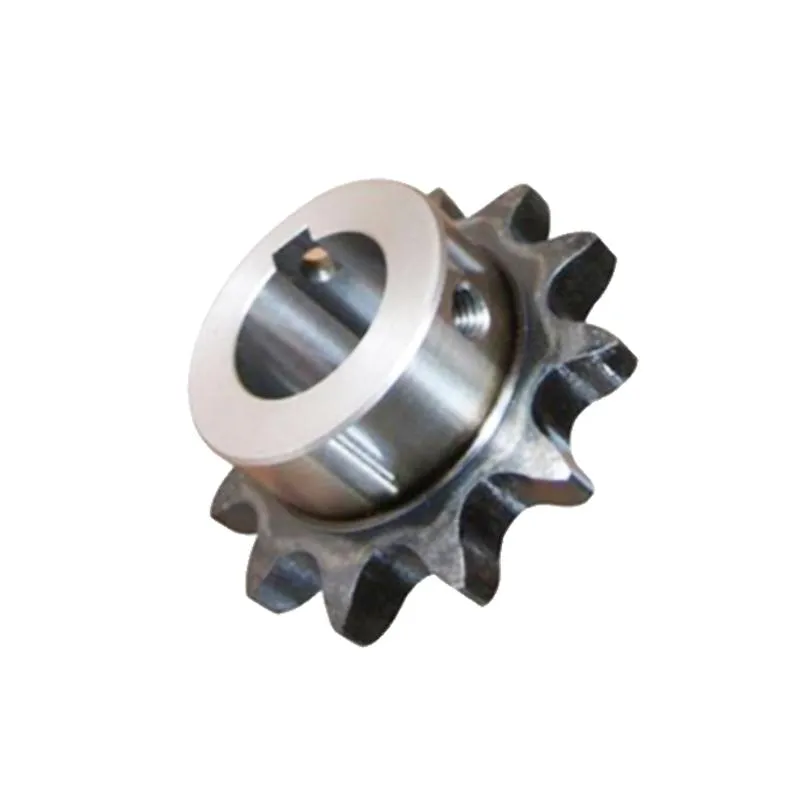
1. Abrasive wear. Hard particles — sand, sugar, cement dust, metal fines — become embedded between the roller and the tooth flank and grind the surface away. This is the dominant mechanism in mining, agriculture and food processing, and it is beaten by higher surface hardness plus effective sealing or a wider lubrication interval.
2. Adhesive wear. Under high load with a marginal lubricant film, micro-welds form between the roller and the tooth and then tear apart, pulling material with them. It shows as scuffing and material transfer on the flank. It is beaten by a proper lubricant film and by avoiding shock loads.
3. Fatigue wear (pitting and spalling). Repeated contact stress initiates subsurface cracks that eventually break out as pits. It is beaten by adequate core hardness and correct tooth geometry — a soft core lets the case collapse.
4. Corrosive wear. Wash-down chemicals, salt and acidic atmospheres attack the surface, and the corrosion products are then rubbed off. Stainless grades or protective coatings stop it.
5. Misalignment and tension wear. A drive that is out of parallel or has the wrong chain slack loads only one side of the tooth, roughly doubling the local pressure. It is beaten by alignment checks and a tensioning routine.
6. Chain elongation driven wear. A stretched chain no longer sits in the root of the tooth; it rides up the flank, reduces the contact area and accelerates wear on both parts. It is beaten by replacing the chain and sprockets as a matched set.
| Mechanism | What it does to the tooth | Best countermeasure | Specification to request |
|---|---|---|---|
| Abrasive wear | Uniform metal loss on the flank | Harder surface plus cleaner lubrication | Case depth 0.8–1.5 mm, surface 55–60 HRC |
| Adhesive wear | Scuffing and material pick-up | Maintain a full lubricant film | Tooth flank roughness Ra ≤ 1.6 µm |
| Fatigue wear | Pitting and spalling at the pitch line | Strong core support under the case | Core hardness 30–40 HRC |
| Corrosive wear | Rough, pitted, discoloured surface | Resistant base material or coating | AISI 304 / 316 or zinc-nickel coating |
| Misalignment wear | One-sided flank loading | Alignment and tension discipline | Bore and keyway to ISO 286 tolerance class |
| Chain elongation wear | Contact point moves up the tooth | Replace chain and sprockets as a set | Matched set supplied with chain pitch certificate |
The scenario: maintenance blames the supplier, the supplier blames the lubrication, and the purchasing officer is left holding a repeat order for the same failed part. Nobody has a written routine, so the same failure returns every season and the annual spend on sprockets keeps climbing.
The solution: turn prevention into a short, auditable routine with named owners. Seven actions cover 90% of the wear you will ever see on a European standard drive. Put them in the maintenance plan and require them in every supply contract.
| Action | Frequency | Owner | Target result |
|---|---|---|---|
| Laser-check shaft parallelism and sprocket alignment | At installation, then every 6 months | Maintenance technician | Angular deviation under 0.5° |
| Verify chain slack against the drive manufacturer's figure | Weekly during the first month | Line operator | Slack within 2–4% of centre distance |
| Re-lubricate with the correct grade and quantity | Per drive duty cycle | Lubrication route | Visible film, no dry flanks |
| Record tooth thickness at the pitch line | Monthly | Planner | Trend flat, below 10% loss |
| Replace chain and sprockets together | At each chain replacement | Purchasing | No mixed-wear pairs in service |
| Keep one matched spare set per critical drive | Continuous | Stores | Zero waiting time on failure |
| Review the failure at every replacement | Per event | Engineering | Root cause closed, not repeated |
The scenario: two suppliers quote the same 16B sprocket at very different prices, both described as "C45 steel, hardened". Without a written specification the buyer cannot see that one is induction hardened to a controlled case depth and the other is simply through-hardened, and the cheaper part will wear out three times faster in a dusty conveyor.
The solution: specify hardness, case depth and material grade explicitly on the purchase order. The table below gives a practical starting point for common duties.
| Application duty | Recommended material | Hardness target | Expected service life |
|---|---|---|---|
| Clean, well-lubricated drive | C45 carbon steel, induction hardened | 50–55 HRC surface | Long, predictable |
| Dusty or abrasive environment | 42CrMo alloy steel, case hardened | 55–60 HRC surface, 0.8–1.5 mm case | Extended, with sealed lubrication |
| Shock and heavy load | 42CrMo, hardened and tempered core | 55–60 HRC surface, 30–40 HRC core | Resists pitting and tooth breakage |
| Wash-down or corrosive atmosphere | AISI 304 or 316 stainless | Solution annealed, passivated | Moderate load, high corrosion resistance |
| Low load, low speed, low budget | C45 steel, through hardened | 35–45 HRC | Acceptable only for light intermittent duty |
The scenario: a buyer is asked "is this sprocket still usable?" and has no reference point, so the part goes back into service well past its safe limit. It then fails mid-shift and takes the chain and the driven shaft with it.
The solution: publish a simple limit table at the machine. When any threshold is crossed, the component is replaced. This turns a judgement call into a rule anyone can apply.
| Measurement | Acceptable | Plan replacement | Replace immediately |
|---|---|---|---|
| Tooth thickness loss at pitch line | Under 5% | 5–10% | Above 10% |
| Chain pitch elongation | Under 1% | 1–1.5% | Above 1.5% |
| Tooth flank roughness | Ra under 1.6 µm | Ra 1.6–3.2 µm | Visible scuffing or pick-up |
| Radial runout of the sprocket | Under 0.1 mm | 0.1–0.3 mm | Above 0.3 mm |
| Crack or missing tooth | None | Monitor daily | Any crack at all |
Q: What causes wear on European Standard Sprockets and How Can I Prevent It?
Wear is caused by abrasive particles between the roller and the tooth, an inadequate lubricant film, cyclic contact fatigue of a soft core, corrosive attack, drive misalignment and a stretched chain riding up the tooth flank. Prevention comes from four controls: a written hardness and case-depth specification, correct alignment and tension, a lubricant film that never breaks down, and replacing chain and sprockets as a matched set.
Q: Are European standard sprockets expected to wear out, or can wear be eliminated?
Some wear is normal and progressive, but premature wear is almost always a specification or maintenance failure rather than an unavoidable property of the component. Buyers who specify case depth, core hardness and surface finish, and who enforce a simple inspection routine, routinely double service life on the same drive.
Q: What causes wear on European Standard Sprockets and How Can I Prevent It when the drive runs in a dusty plant?
In dusty plants abrasives dominate, so the answer is harder surfaces and better containment. Request induction or case-hardened teeth at 55–60 HRC, use sealed or encapsulated chain where possible, shorten the lubrication interval, and wash down the drive area rather than the chain itself. A soft through-hardened sprocket in this environment will fail early no matter how well it is aligned.
Q: How quickly should a worn sprocket be replaced?
Replace as soon as tooth thickness loss passes 10% or chain pitch elongation passes 1.5%. Beyond those points the contact geometry degrades quickly, load concentrates on a small area, and the risk of sudden tooth fracture or chain jump rises sharply.
The scenario: a procurement team needs 06B to 20B sprockets with consistent hardness, matched bores and a documented inspection report, but the current supplier sends parts with no material certificate and variable case depth between batches.
The solution: work with a manufacturer that treats the specification as the product. Raydafon Technology Group Co.,Limited produces European standard finished-bore sprockets from 06B through 20B with controlled material grade, documented hardness and case depth, and dimensional inspection against DIN 8187 and ISO 606. Every order can be supplied with a matched chain and sprocket set so that wear partners stay in step from day one.
| What buyers ask for | What Raydafon Technology Group Co.,Limited delivers |
|---|---|
| Consistent tooth hardness | Controlled induction or case hardening with recorded values |
| Accurate bore and keyway | Finished bore to ISO 286 tolerance class, ready to mount |
| Correct standard profile | DIN 8187 / ISO 606 geometry for 06B, 08B, 10B, 12B, 16B and 20B |
| Traceability | Material and inspection documentation with each batch |
If your line is losing time to repeat sprocket failures, send us the drive details and duty cycle. Our engineering team will recommend the material, hardness and lubrication interval that fit your application, and quote a matched sprocket and chain set so the next replacement is planned, not panicked. This is the practical answer to What Causes Wear on European Standard Sprockets and How Can I Prevent It? — measure it, specify it, and buy it from a partner who documents it.
Raydafon Technology Group Co.,Limited is a manufacturer and exporter of power transmission components, specialising in European standard chain sprockets, finished-bore sprockets from 06B to 20B, stainless steel sprockets, plate wheels and matched roller chains for conveying, packaging, agricultural and industrial drives. We support procurement teams with clear specifications, stable batch quality, inspection reports and responsive technical advice, so that wear becomes a predictable maintenance item instead of an emergency. Explore the full range at https://www.raydafon-power.com or send your drawing, duty cycle and annual quantity to [email protected] and our engineers will reply with a recommended specification, a prevention checklist and a quotation within one working day.
Wang, L., Zhang, Q., & Xu, M. (2018). Failure analysis of sprocket wear in industrial chain drives. Engineering Failure Analysis, 92, 245–256.
Ding, H., Zhao, S., & Liu, Y. (2020). Effect of hardness on the abrasive wear resistance of medium-carbon steel sprockets. Wear, 456–457, 203–214.
Sun, J., & Chen, K. (2017). Elongation behaviour of roller chains and its influence on sprocket tooth wear. Mechanism and Machine Theory, 118, 88–101.
Niu, X., Li, Z., & Gao, F. (2021). Contact stress and fatigue life prediction of sprocket teeth under heavy load. International Journal of Fatigue, 145, 106–119.
Petrović, M., & Ilić, D. (2019). Lubrication strategies for reducing wear in chain drives. Tribology International, 135, 210–221.
Kim, S., Park, J., & Lee, H. (2022). Microstructural effects of induction hardening on sprocket wear performance. Surface and Coatings Technology, 430, 127–138.
Rossi, A., & Bianchi, F. (2016). Preventive maintenance scheduling for industrial chain transmission systems. Journal of Manufacturing Systems, 41, 55–64.
Adeyemi, O., & Bello, K. (2020). Abrasive wear of sprockets in dusty conveyor environments. Tribology Transactions, 63(4), 712–724.
Tanaka, H., & Suzuki, R. (2018). Standardization of chain sprocket dimensions in European machinery design. Proceedings of the Institution of Mechanical Engineers, Part C: Journal of Mechanical Engineering Science, 232(15), 2761–2773.
Novak, P., & Horák, J. (2021). Case study: root cause analysis of premature sprocket failure in agricultural machinery. Engineering Failure Analysis, 124, 105–118.