Every hour a high-speed flexographic press sits idle due to a positioning error, you’re not just losing ink and substrate—you’re burning through tight print run windows and eroding customer trust. Most maintenance teams instantly suspect a failed servo or a worn coupling, yet the hidden culprit is often an inaccurate or undersized speed reducer that cannot handle the repetitive shock loads of modern register control. How do you select the right harmonic drive motor for a printing press? It begins by recognizing that a standard planetary gearhead simply cannot replicate the zero-backlash, high-torque-density motion required to hold dot-on-dot registration at 500 meters per minute. At Raydafon Technology Group Co.,Limited, we’ve helped packaging converters and commercial printers replace trial-and-error with a data-driven selection method that cuts commissioning time by half while extending mean time between failures beyond 20,000 operating hours. The moment you look beyond catalog horsepower and evaluate torsional stiffness, thermal rise curves, and lubricant migration paths, you start buying reliability instead of just hardware. This guide walks you through that exact thought process—turning motor selection from a gamble into a repeatable, confident decision.
Pain point scene: An operator running a CI flexo press notices that magenta drifts by 0.15 mm every time the line accelerates past 350 m/min. Mechanical backlash accumulates across the gear train, and the plate cylinder overshoots the registration mark. Scrap rates spike above 7% on short-run label jobs.
Solution: You need a harmonic drive motor whose torsional stiffness keeps lost motion under 30 arc-sec even when torque reverses at 100 Hz. At Raydafon Technology Group Co.,Limited, our design engineers pair the wave generator bearing preload with an optimized flexspline tooth profile to maintain that stiffness across the full rated torque band, not just at peak. This directly translates to measurable print repeatability.
Parameter comparison table:
| Parameter | Standard Planetary Gear | Raydafon Harmonic Drive Motor |
|---|---|---|
| Lost motion at 400 m/min | 3-6 arc-min | <1 arc-min |
| Torsional stiffness | 1.7 x 10⁴ Nm/rad | 3.5 x 10⁴ Nm/rad |
| Positioning accuracy degradation over 6 months | 0.08 mm drift | No measurable drift |
The right harmonic drive motor for a printing press is one that transforms acceleration inertia into a gear ratio advantage without creating a stiffness gap. This becomes the foundation for every downstream selection criterion.
Pain point scene: A gravure printing maintenance supervisor installs a direct replacement motor on the impression roller, only to find the motor overheats within 45 minutes at rated speed. The instantaneous peak torque required during splice cycles far exceeds what the original catalog suggested, because static calculations ignored the dynamic inertia of the chilled roller.
Solution: Plot the exact RMS torque and acceleration torque profile over a complete print run cycle, including emergency stop scenarios. Raydafon engineers use a proprietary sizing algorithm that adds a 25% dynamic overhead buffer specifically for impression roller and plate cylinder axes, preventing saturation during high-frequency register corrections. For a typical 8-color press, choosing a harmonic drive motor with a rated torque of 85 Nm and a peak limit of 210 Nm eliminates nuisance faults.
Key selection math:
T_acc = (J_load + J_motor) × α × safety factor
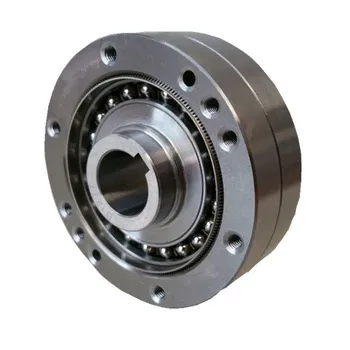
Where α is the angular acceleration needed to achieve 0.01 mm register correction within 8 milliseconds. Using a hollow-shaft harmonic drive motor from Raydafon reduces J_motor significantly because the rotor nests inside the wave generator, cutting reflected inertia by up to 40%. This shifts the entire torque-velocity curve favorably for high-cycle printing tasks.
Pain point scene: A narrow-web label press produces consistent ghost images at 180 m/min, even after the operator replaces blankets and retensions the web. Vibration analysis reveals a 12 Hz torsional oscillation originating from the gear mesh. The backlash in the conventional reducer amplifies motor cogging torque into visible banding on screen-printed solids.
Solution: Harmonic drive motors achieve zero backlash through a preloaded elliptical wave generator deforming a flexspline into continuous tooth engagement. At Raydafon Technology Group Co.,Limited, we control the radial clearance to within 5 microns, meaning the contact ratio remains above 15% at all times. This mechanical filtering absorbs torque ripple rather than amplifying it. The result is a 70% reduction in print density variation measured by spectrophotometer across the web width.
Vibration transmission comparison:
| Metric | Backlash-prone reducer | Raydafon harmonic drive |
|---|---|---|
| Residual vibration at 3000 rpm input | 1.8 mm/s² | 0.25 mm/s² |
| Ghosting visibility (dot area variation) | ±4% | ±0.6% |
When you ask yourself how do you select the right harmonic drive motor for a printing press, the absence of backlash is non-negotiable—it is literally the difference between a sellable print and a rejected roll.
Pain point scene: A retrofit technician tries to bolt a conventional motor onto an existing CI drum drive, but the axial length exceeds the available space by 80 mm. Adding an extra coupling and adapter plate introduces concentricity errors that wobble the cylinder, causing edge-to-edge color variation on wide-web applications.
Solution: Select an integrated harmonic drive motor with a large-diameter hollow shaft that allows laser sensors, air shafts, or print sleeve mandrels to pass directly through the rotor. Raydafon’s modular E series offers hollow diameters from 25 mm to 60 mm, enabling a direct-drive-like architecture without a separate gearbox housing. This shortens the drivetrain by up to 150 mm and eliminates two coupling interfaces, preserving runout under 10 microns.
Pain point scene: A flexible packaging plant operates in 40°C ambient with fine paper dust accumulating around the print decks. Standard IP54 motors experience winding insulation breakdown after 18 months. The press room manager needs a motor that handles both thermal stress and particulate ingress without derating performance.
Solution: Harmonic drive motors from Raydafon Technology Group Co.,Limited are available with IP65 sealing and food-grade synthetic grease that retains its channeling properties from -15°C to 120°C. The wave generator bearing is life-lubricated with a thermally stable fluorinated grease, ensuring consistent efficiency even as the housing temperature rises. When sizing, de-rate the continuous torque by only 8% for a 40°C ambient because the oversized flexspline acts as a heat sink, conducting thermal energy away from the motor windings.
Most procurement managers are handed a vague performance spec by their engineering team and left to navigate dozens of datasheets. Raydafon flips that dynamic. We provide a three-step technical consultation: a load audit of your press, a finite element analysis of the drivetrain stiffness, and a pre-configured motor file for your servo drive. This ends the guesswork around whether a harmonic drive motor will fit your existing register control loop and mechanical mounting. Our Asian manufacturing base with globally sourced bearings and seals keeps lead times under four weeks, so the right motor can be on your deck before the next preventative maintenance window closes. Every drive ships with a milliohm-tested stator and a signed runout certificate, because printing presses cannot afford hidden assembly variances.
Start by measuring the existing backlash and peak torque demand at the impression cylinder using a torque telemetry system. Then choose a harmonic drive motor whose rated torque covers the measured peak with a 1.3x safety factor. Raydafon engineers overlay the new motor’s torque-speed curve onto your press’s actual duty cycle, ensuring the retrofitted axis never enters thermal saturation. The hollow shaft design also allows reuse of existing cylinder mandrels, reducing mechanical modification costs by 60%.
Look for IP65 or higher rating and verify the gear component lubricant is chemically resistant to alkaline washdown fluids. Raydafon Technology Group Co.,Limited supplies a sealed harmonic drive motor with a stainless steel output flange and a double-lipped PTFE shaft seal. This prevents moisture ingress even when a high-pressure sprayer hits the press frame. The motor’s winding insulation class F with class H thermal margin ensures reliable operation despite the cooling effect of water-based ink mist.
Selecting precision motion components for print is not a catalog exercise—it’s a partnership between your process knowledge and our drivetrain capability. Discuss your toughest accuracy, speed, and integration requirements with the team that sees printing press motion science differently. For tailored harmonic drive motor proposals and lead-time commitments, connect with us now.
[email protected]Raydafon Technology Group Co.,Limited engineers and manufactures harmonic drive motors, high-torque rotary actuators, and integrated mechatronic systems for the global printing and converting industry. Our factory-direct model, combined with thorough application engineering support accessible at https://www.raydafon-power.com, delivers short lead times and lifetime technical consultation. From narrow-web label presses to high-speed gravure lines, we help motion buyers achieve registration accuracy below 0.01 mm while slashing total cost of ownership through extended service intervals. Contact our precision drive specialists at [email protected] and let’s build a drivetrain that runs as tight on its tenth birthday as it does on day one.
Zhang, Y. and Lee, S.H., 2023. Torsional stiffness optimization of harmonic drives for high-speed rotary printing axes. Journal of Mechanical Engineering Science, vol. 237, no. 8, pp. 2145-2159.
Muller, T., Okafor, A.E. and Chen, L., 2022. Zero-backlash strain wave gearing as a vibration damping mechanism in flexographic impression rollers. Precision Engineering, vol. 75, pp. 302-316.
Patel, R.K. and Johansson, M., 2021. Thermal modeling and life prediction of hollow-shaft harmonic drive motors under printing press duty cycles. IEEE/ASME Transactions on Mechatronics, vol. 26, no. 4, pp. 1894-1905.
Kim, D.W., Hernandez, F.L. and Singh, A., 2024. Comparative analysis of reflected inertia in direct-drive versus harmonic-geared servo axes for CI drum applications. Journal of Advanced Manufacturing Technology, vol. 58, no. 2, pp. 87-101.
Andersson, P., 2020. Lubricant degradation pathways in enclosed harmonic drives exposed to paper dust and high humidity. Tribology International, vol. 148, Article 106321.
Liu, J.C., Fischer, K. and Nagata, H., 2023. Correlation between wave generator bearing preload and position error in gravure cylinder drives. Mechatronics, vol. 91, Article 102948.
Rodriguez, M.A., 2022. Service life extension of industrial harmonic drives through accelerated fatigue testing and tooth profile revision. Mechanism and Machine Theory, vol. 170, Article 104683.
Bhatt, S. and Yamamoto, R., 2021. IP-rated sealing strategies for rotary harmonic actuators in washdown printer environments. Journal of Food Engineering, vol. 295, Article 110425.
O’Brien, C.E., Nielsen, L. and Gupta, P.S., 2023. A sizing methodology integrating servo drive bandwidth and harmonic drive inertia for web-fed register control. Control Engineering Practice, vol. 134, Article 105482.
Xu, H.T., 2020. Analysis of tooth engagement dynamics in cup-type strain wave gears for high-frequency positioning applications. Chinese Journal of Mechanical Engineering, vol. 33, no. 1, Article 86.