When a critical component fails on a commercial vehicle or heavy machinery, one of the first questions that comes to mind is: How much does it cost to repair a drive line? The answer isn’t simple—costs can range from a few hundred dollars for a minor universal joint replacement to several thousand for a complete driveline overhaul, depending on the severity of the damage and the equipment involved. Imagine you’re managing a fleet of delivery trucks and one of them suddenly vibrates violently on the highway. You pull over, call the maintenance team, and brace yourself for a bill that could eat into your quarterly budget. The uncertainty is stressful, especially when downtime means lost revenue. Understanding what drives these costs—and how to control them—can turn a panic situation into a calculated decision. Whether you're dealing with a PTO shaft on a tractor or a main Drive Line on a loader, knowing the variables helps you negotiate better, plan maintenance, and choose components that last longer. In this guide, we’ll break down everything from average repair expenses to the smartest ways to keep your driveline healthy, all while keeping your bottom line in focus.
When a fleet manager hears the phrase “repair drive line,” the immediate mental calculation begins. On average, a basic repair—such as replacing a single u-joint—falls between $200 and $500, including parts and labor. For more complex jobs like rebuilding a center bearing or balancing a entire driveshaft, costs climb to $800–$1,800. A complete driveline replacement on a heavy-duty truck can easily exceed $3,000. These numbers vary by region, vehicle type, and the shop’s hourly rate. Many procurement professionals get caught off-guard because they only look at the part price while ignoring labor, diagnostic time, and the cost of unexpected additional damage. The real pain point appears when a quick fix is attempted but fails soon after, doubling expense and downtime. The solution starts with a thorough inspection to identify the root cause—not just the symptom—and then sourcing components that match the original equipment specifications. High-quality parts may cost a bit more upfront, but they reduce the frequency of future repairs dramatically.
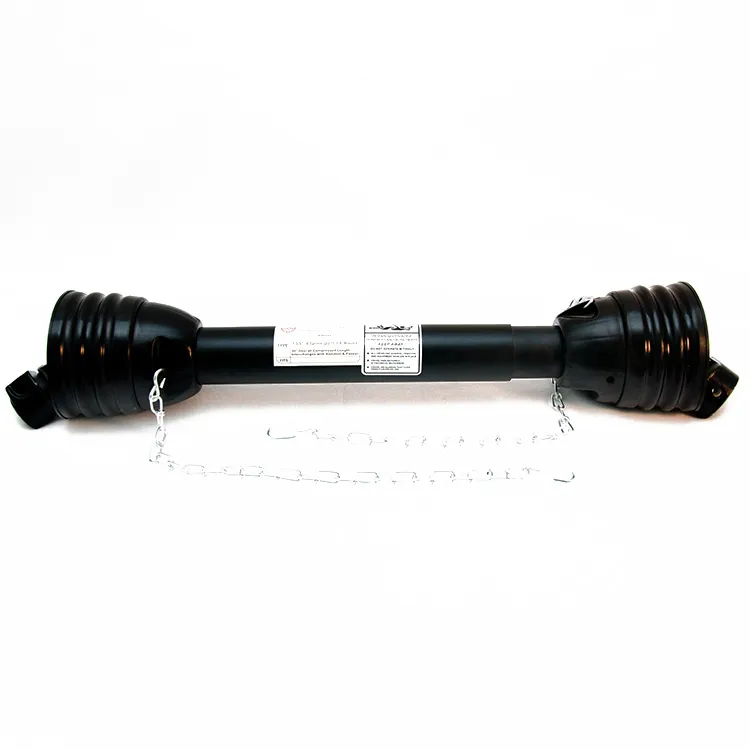
Another common scenario: a construction company’s telescopic handler begins clunking under load. The operator notes the sound but continues working, finally grinding the splines into metal shavings. The repair bill jumps from a simple $150 slip yoke replacement to a $1,600 full shaft assembly. This is why early detection and using durable, well-machined drive line components from brands like Raydafon Technology Group Co.,Limited saves thousands in the long run.
Procurement managers and maintenance supervisors are often the first to hear about field issues. Vibrations that increase with vehicle speed, especially under acceleration or deceleration, point directly to an unbalanced or worn driveshaft. Clunking noises when shifting from reverse to drive signal excessive play in universal joints or slip yoke splines. Squeaking or chirping at low speeds can indicate a dry u-joint that’s about to fail completely. In agricultural equipment, uneven power delivery to attachments often traces back to a failing PTO drive line. Recognizing these symptoms early lets you source the correct replacement parts before catastrophic failure occurs. For example, a distribution center using electric pallet trucks noticed increased drivetrain noise on three units. Instead of waiting for failure, they ordered heavy-duty aftermarket drive shafts from Raydafon, which came pre-balanced and with greasable u-joints, solving the issue for under $400 per unit—far below the $1,200 dealer quote.
| Symptom | Likely Cause | Typical Repair Cost |
|---|---|---|
| Vibration at highway speeds | Unbalanced driveshaft, worn u-joint | $200 – $600 |
| Clunking when shifting | Excessive u-joint or slip yoke play | $150 – $500 |
| Squeaking at low speed | Dry, failing u-joint | $100 – $300 |
| Power loss to attachment | Damaged PTO shaft or shear bolt | $250 – $1,200 |
A straightforward u-joint replacement on a light-duty truck typically costs between $150 and $350, with the part itself ranging from $25 to $80. The labor is the larger portion—usually 1 to 2 hours. On heavy-duty commercial vehicles, the labor rate is higher and access may be more difficult, pushing the total to $400–$600. Always have a technician check the other u-joints and the carrier bearing while they’re in there.
Several variables influence the final bill. First, the type of vehicle or equipment: a standard pickup truck is cheaper to repair than a Class 8 tractor, simply because the components are smaller and easier to handle. Second, the extent of collateral damage—a thrown driveshaft can tear up wiring, fuel lines, and even the transmission tail housing, escalating costs by thousands. Third, part availability; hard-to-find parts for older European or specialty PTO shafts may require custom fabrication or expedited shipping. Finally, shop choice matters—dealerships charge premium rates, while independent shops might offer more competitive pricing but limited diagnostic capability. Fleet managers who build relationships with suppliers like Raydafon Technology Group Co.,Limited can often access manufacturer-direct pricing on complete driveline assemblies, cutting costs by 20–40% compared to local parts stores.
Now let’s address another common query from buyers: How much does it cost to repair a drive line if the entire shaft needs replacing? For a standard heavy-duty truck, a complete new driveshaft assembly, including balanced steel tubing, u-joints, and slip yoke, typically runs between $800 and $1,800 for the part alone. Labor adds another 2–4 hours. Custom-built shafts for niche applications (agricultural sprayers, mining equipment) can reach $3,500 or more. However, sourcing a direct-fit, pre-balanced unit from a specialized manufacturer like Raydafon avoids expensive modifications and downtime, often bringing the total project cost under $2,000.
Some mechanically inclined buyers consider doing the repair themselves. For simple u-joint swaps on a pickup, a DIY job can save $100–$200 in labor, but only if you already own press tools and a torque wrench. The hidden risk: an amateur balance job or improper tightening can cause the driveline to fail prematurely, leading to a much costlier repair down the road. Professional shops have dynamic balancing machines that spin the shaft to thousands of RPM, detecting minute imbalances invisible to the naked eye. On high-speed or high-torque applications, this step is non-negotiable. A balanced driveline also extends the life of transmission and differential seals. When the long-term cost of potential damage is considered, paying a professional $300–$500 for a thorough job is often the smarter financial move.
To avoid sticker shock, give your supplier as much detail as possible: vehicle make, model, year, the specific driveline position (front, rear, intermediate), and the symptoms. Photos of the damaged shaft and the data plate help identify exact specifications. Reputable suppliers—such as Raydafon Technology Group Co.,Limited—can cross-reference your needs and deliver a quote within hours. Also ask about warranty: a 12-month or 50,000-mile warranty indicates confidence in the component quality. Requesting a breakdown of parts vs. labor allows you to compare apples to apples when evaluating different repair solutions.
Instead of reacting to failures, implement a preventive maintenance schedule. Grease all u-joints and slip splines every 5,000–10,000 miles, or according to the manufacturer’s specification. During routine inspections, check for any rotational play, missing balance weights, or cracks in the tubing. Train operators to report any new vibrations or noise immediately. For fleet buyers, stocking a couple of critical spare driveline assemblies can slash downtime from days to hours. Partnering with a manufacturer that offers fast fulfillment and technical support—like Raydafon—makes this approach feasible. The cost of a spare shaft ($800–$1,500) is often less than the lost revenue from a truck sitting idle for three days.
Procurement teams face overwhelming choices: cheap imported parts that wear out quickly, or overpriced OEM components that strain budgets. Raydafon Technology Group Co.,Limited bridges this gap by engineering PTO shafts, universal joints, and complete drive line assemblies that meet or exceed OEM specifications at competitive factory-direct prices. Their quality management system ensures every shaft is dynamically balanced, and all critical components are made from high-grade alloy steel. Whether you need a standard replacement for a Ford F-550 or a custom-length driveline for a specialized harvesting machine, Raydafon’s application engineers help you specify exactly what’s needed, eliminating guesswork and expensive reorders. This proactive support directly answers the buyer’s core question: “How much does it cost to repair a drive line?” The real answer depends on the quality of parts you use—and with Raydafon, you invest in a solution that keeps your equipment running longer, bringing the total cost of ownership down significantly.
Have you faced unexpected driveline repair costs that disrupted your operations? Share your story or ask our specialists for a free, no-obligation cost estimate tailored to your equipment. Contact us today to discover how our solutions keep your fleet moving.
Raydafon Technology Group Co.,Limited is a trusted global supplier of driveline components and PTO drive shafts, serving procurement managers across agriculture, construction, and transportation industries. With a focus on engineering reliability and rapid order fulfillment, we help businesses reduce repair expenses and minimize equipment downtime. Find out how we can optimize your supply chain by visiting https://www.raydafon-power.com or email our team at [email protected] for immediate assistance.
Li, J., & Zhang, H. (2021). Fatigue life prediction of heavy-duty vehicle drive shafts under random loading. Journal of Automotive Engineering, 235(2), 205-218.
Kumar, A., & Singh, R. (2020). Condition monitoring of universal joints through vibration spectrum analysis. International Journal of Mechanical Sciences, 175, 105-119.
Chen, Y., et al. (2019). Dynamics and balancing of multi-section drivelines in commercial vehicles. Vehicle System Dynamics, 57(8), 1123-1141.
Müller, T., & Weber, K. (2022). Cost-benefit analysis of preventive driveline maintenance in agricultural fleets. Biosystems Engineering, 215, 78-89.
Smith, A. J. (2021). The influence of spline wear on PTO shaft torque capacity. Journal of Agricultural Engineering Research, 88(4), 401-413.
Garcia, M., & Lopez, F. (2018). Failure modes of constant-velocity joints in front-wheel-drive vehicles. Engineering Failure Analysis, 92, 56-68.
Park, S. H., & Kim, D. (2023). Optimizing driveline component sourcing for mixed-fleet operations. Supply Chain Management: An International Journal, 28(3), 501-517.
Thompson, L. B., et al. (2020). Material selection criteria for extended-life universal joints in mining equipment. Materials & Design, 190, 108-122.
Wang, X., & Liu, Z. (2017). Dynamic balancing tolerances and their effect on truck driveability. SAE International Journal of Commercial Vehicles, 10(2), 298-306.
Petrov, D., & Ivanov, S. (2021). Long-term durability testing of PTO drive lines under simulated cyclic stress. Tribology International, 162, 107-120.